
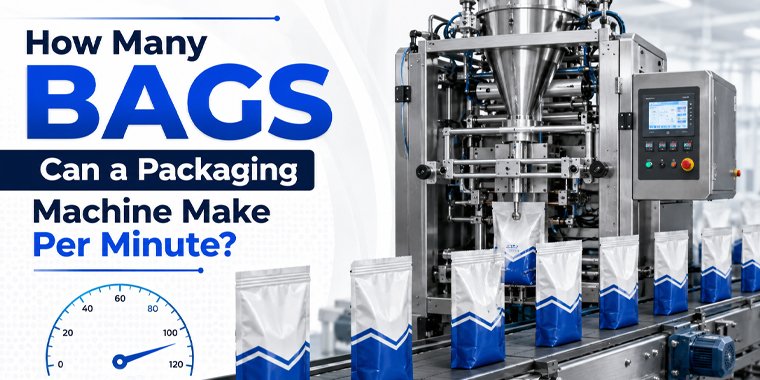
Speed is very important in today’s packaging. When you have a slow packaging line, it hurts the whole production of your company, resulting in delays, increased expenses, and lost opportunities.
Then a question arises in mind, what is the number of bags that a packaging machine can produce per minute? The average packaging machine can fill 20 to 300 or more bags in one minute, depending on the type of machine, product, and configuration. This range can even be surpassed by high-speed industrial systems. Knowing the exact number will assist you in scaling production, decreasing downtimes, and raising profitability.
We will divide machine types, real output ranges, critical factors that influence speed, and practical means of improving performance in this guide. This article will provide you with practical and specific information in case you want to become more efficient.
What Is a Packaging Machine?
A packaging machine is an automated mechanism that shapes, fills, and seals bags or pouches containing products in a fast and reliable manner. The machines find application in almost all industries, such as food, pharmaceutical, agricultural, and retail sectors. Why? They:
- Eliminate manual labor
- Reduce errors
- Increase production speed
Machine Technology Level:
Modern automatic pouch filling machines come with cutting-edge features such as:
- Precision control with servo motors
- PLC automation systems
- Weighing systems with many heads
- Intelligent sensors to identify errors
Greater consistency and a higher feasible BPM are typically associated with stronger technology.
Bags Per Minute by Machine Type
We shall consider real production rates according to industry standards. The functions of each packaging machine are different, and they have a direct impact on output. Learning these differences will enable businesses to select the appropriate system.
| Machine Type | Speed (Bags/Min) | Best For | Key Advantage |
| VFFS | 30–200 | Powders, grains | Versatility |
| HFFS | 40–300 | Solid items | High speed |
| Pre-Made Pouch | 20–80 | Premium products | Superior appearance |
01. Vertical Form Fill Seal (VFFS)
Vertical Form Fill Seal machines are common in industries where there is a need to package loose or flowable products continuously. Their vertical organization enables them to utilize the space effectively and promise that they have a stable production. The idea behind these machines is to offer a balance between speed and flexibility.
Normal Speed: 30-200 bags/minute.
Best for: Snacks, rice, spices, powders.
Merit: Consistent high efficiency
02. Horizontal Form Fill Seal (HFFS)
Horizontal Form Fill Seal machines are constructed with a high degree of precision, speed, and, in particular, with solid or uniform-shaped products. The horizontal design also helps in precise placement and sealing, which is more consistent in high-volume production.
Average Speed: 40-300 bags per minute.
Best for: Bakery products, chocolates, bars.
Benefit: quicker production of homogeneous shapes.
03. Pre-Made Pouch Machines
Ready-to-use pouch machines are best suited to companies that are concerned with the quality and visual attraction of their packaging. Such machines fill and close ready-to-use pouches rather than creating bags, which produces a high-quality finish. Although not as fast as other systems, they provide superior accuracy and a uniform packaging outcome.
Average Speed: 20-80 bags per minute.
Best for: Premium packaging products
Pro: Quality sealing and looks.
Calculation of Bags per Minute

Order This Kind Of Boxes In Best Quality From Us →
It is easy to know the output of your machine.
Formula: ( Number of Bags Produced) / (Time in minutes) = Output
Example: 6,000 bags ÷ 60 minutes = 100 bags per minute
This calculation can assist you not only in measuring efficiency but also in identifying performance gaps and planning production schedules.
Also Read: A Comprehensive Guide to Pre-Roll Machine Knowledge
The Major Considerations that Influence Bagging Rate
Even a good machine will not work at optimum speed without appropriate conditions. Output is affected by several factors.
Product Type:
Machines are highly dependent on the nature of the product they are packing. Free-flowing products such as grains or powders are usually filled faster, whereas sticky products, fragile products, or irregularly shaped products are more delicate. Further, liquids can also slow down the sealing process as there is a risk of spillage.
Bag Size and Design:
The size and structure of bags play a great role in determining the speed of packaging. Smaller and simpler bags can be filled and sealed in less time, whereas bigger bags take more time since the volume and space of sealing are larger. Stand-up pouches or custom shapes are complex and might need further changes.
Machine Technology:
The performance of a packaging machine is directly proportional to the level of technology involved in the machine. In comparison to the old methods of using pneumatic machines, modern servo-driven machines are much faster and more precise in their movements.
Material Type:
The packaging material is also important in the efficient functioning of a machine. Multi-layer or thicker films take longer to seal, and this can slow the process of production. The materials used can tear, misalign, or jam frequently due to low quality.
Besides, selecting the appropriate material with adequate heat-sealing characteristics is a decision that will guarantee smooth functioning.
Operator Efficiency:
Despite modern automation, the skills of operators are needed to ensure maximum speed. Experienced operators are capable of establishing machines quickly, troubleshooting, and maintaining stable performance. Lack of training or poor handling will usually result in delays and prolonged downtimes.